How to Get a US Phone Number Without a SIM Card: 5 Options Compared
You do not need a plastic SIM card to get a US phone number anymore. Depending on what you actually need the number for, you can receive a one-time text in a browser, add a second line through an app, activate an eSIM, or set up a virtual business line.
The important part is choosing the right tool. A free public number may be enough for a low-risk test or a one-time signup, but it is a poor choice for an account you plan to keep. An eSIM or a private number costs more, yet gives you far more control.
If you only need to receive a non-sensitive message, the quickest option is to choose a free US temporary number, copy it in full international format, and watch its online inbox. Remember that free inboxes are public, so they should never be used for banking, payments, account recovery, or private conversations.
This guide explains the five main ways to get a US number without a physical SIM, what each option can and cannot do, and how to avoid the mistakes that cause verification texts to fail.
The short answer
Yes, you can get a US phone number without inserting a physical SIM card. Your best option depends on how long you need the number and how private the messages must be:
Use a public temporary number for a low-risk, one-time incoming SMS.
Rent a private SMS number when the message should not appear in a public inbox.
Use a second-number app when you want an extra line for regular calls or texts.
Choose an eSIM mobile plan when you need a longer-term number tied to a cellular plan.
Set up a business VoIP number for customer calls, support, or other legitimate business communication.
No option is automatically best. A disposable number is convenient because it is quick; a number you control is safer because it remains yours.
Five ways to get a US number without a physical SIM
1. Use a free public temporary US number
A public temporary number receives SMS messages on a web page rather than on a phone in your hand. You select a number, enter it into the website or app sending the message, and then open that number's inbox in your browser.
This is the simplest choice when you need one incoming message and the account or activity is not sensitive. It can also be useful for developers and QA teams testing whether an application sends an SMS correctly.
The convenience comes with an important tradeoff: the inbox is shared. Anyone who opens the same page may be able to read the messages delivered to that number. The number may also be rotated, reused, or blocked by a service that has seen it before.
Best for: low-risk trials, testing an SMS flow, and avoiding marketing messages on your personal line.
Not suitable for: banking, financial services, government accounts, cryptocurrency, personal conversations, account recovery, or any account you would be upset to lose.
2. Rent a private virtual number
A private virtual number works through an account or online dashboard, but its inbox is not deliberately published for everyone to see. Depending on the provider, you may rent it for one activation, a few hours, a month, or longer.
Privacy is the main advantage over a free public number. You are not sharing the message page with every visitor. Some providers also let you choose a country, service, or rental period before paying.
Private does not necessarily mean permanent, however. The number may return to the provider after your rental ends, and it may still be classified as VoIP or virtual. That matters because some websites check a number's line type before sending a code.
Before paying, confirm three things:
Whether the number can receive SMS from the sender you need.
How long you keep access to the number.
What happens if the message never arrives.
Best for: a short-term message that should not appear in a public inbox.
Not suitable for: long-term account recovery unless the provider guarantees that you retain the number.
3. Add a second number through an app
Second-number and burner-style apps give you another line inside a mobile or desktop application. Many support two-way texting and voice calls, making them more flexible than receive-only websites.
This option makes sense when you want to separate personal and casual communication without carrying another phone. For example, you might use a second line for marketplace listings, short projects, community groups, or a temporary contact number.
The word “burner” can be misleading. An app-based number is not always anonymous, disposable, or accepted by every verification system. You may need an account and subscription, and the provider may recycle the number if you stop paying. Many of these numbers are also classified as VoIP.
Best for: ongoing calls and texts where an app-based line is acceptable.
Not suitable for: services that require a carrier mobile number or verified ownership.
4. Activate a US eSIM plan
An eSIM is a digital SIM built into a compatible phone. It allows a carrier plan to be activated without inserting a physical card. Apple describes eSIM as an industry-standard digital SIM that removes the need for a physical SIM card.
An eSIM can be the strongest option when you need a number for weeks, months, or longer. If the plan includes voice and SMS, it behaves much more like a normal mobile line than a public inbox or temporary app number.
But do not assume that every eSIM includes a phone number. Many travel eSIM plans provide mobile data only. Before buying, look specifically for:
A US phone number, not just US data coverage.
Incoming SMS support.
Voice support if you need calls.
The plan's validity period and renewal rules.
Compatibility with your exact device.
Best for: a longer-term number, travel, dual-line use, and people who need a cellular plan without a physical SIM.
Not suitable for: someone who needs only one free, non-sensitive text.
5. Set up a business VoIP number
A business VoIP number routes calls and, when supported, text messages through an internet-based service. It can ring on several devices, support business hours, and provide features such as voicemail, call routing, and team access.
This is usually the most practical choice for a company that wants a recognizable US contact number without maintaining a separate phone for every employee. It is built for ongoing communication rather than one-time verification.
The limitation is that a VoIP business line is still a VoIP line. Consumer platforms may detect that classification and decline to use it for account verification. Twilio's documentation, for example, shows that phone numbers can be identified as mobile, landline, fixed VoIP, or non-fixed VoIP. A valid-looking +1 number is therefore not automatically treated like a US mobile number.
Best for: customer support, sales calls, appointment lines, and legitimate business communication.
Not suitable for: pretending to have a personal mobile line or bypassing a platform's verification rules.
US phone number options compared
Option | Typical cost | Inbox privacy | Calls | Best length of use | Best use case |
|---|---|---|---|---|---|
Public temporary number | Free | Public and shared | Usually no | Minutes or one-time use | Low-risk incoming SMS and testing |
Private rented number | Paid | Private during rental | Varies | One message to several weeks | Short-term private SMS |
Second-number app | Free or subscription | Account-based | Often yes | Weeks or months | A separate casual line |
eSIM mobile plan | Paid | Private | Depends on plan | Weeks to long term | A mobile line without a physical SIM |
Business VoIP number | Subscription | Account or team-based | Yes | Long term | Business calls and messaging |
The table highlights the real decision: are you optimizing for speed, privacy, or long-term control? You usually cannot maximize all three for free.
How to choose the right option
Start with the purpose of the number, not the marketing label attached to it.
You need one non-sensitive SMS
A free public temporary number is usually the fastest solution. Treat the inbox as if it were displayed on a public noticeboard. If the contents should not be public, choose another option.
You need a private message for a short period
Consider a private rental. Check the rental window and whether you can receive another code later. Losing access after the first message can make account recovery difficult.
You want a second number for regular communication
A second-number app may provide the right balance of convenience and cost. Confirm whether it supports both calls and SMS and whether the number remains yours while your account is active.
You need a number you can keep
Choose a renewable eSIM plan or a carrier number registered to you. This costs more, but long-term ownership matters when the number is connected to your identity, work, or important accounts.
You need a number for a business
Use a business phone or VoIP provider designed for customer communication. Do not use a public SMS inbox as a company's permanent contact or recovery number.
How to receive a text on a temporary US number
For a low-risk, permitted use case, the process is straightforward:
Open a list of available US numbers.
Choose a recently active number.
Copy the entire number, including the
+1prefix.Select United States in the sender's country menu, if it has one.
Paste the number and request the SMS.
Return to the number's online inbox and wait for the message.
Messages do not always arrive. If nothing appears after a reasonable wait, recheck the format, request the message once more, or try a different number. Repeatedly requesting codes in a short period may trigger the sender's rate limits, so avoid hammering the resend button.
Never use this process to evade a ban, create deceptive accounts, impersonate someone, or break a service's terms. A temporary number changes where a message is delivered; it does not remove your responsibility to use the service lawfully.
What does a valid US phone number look like?
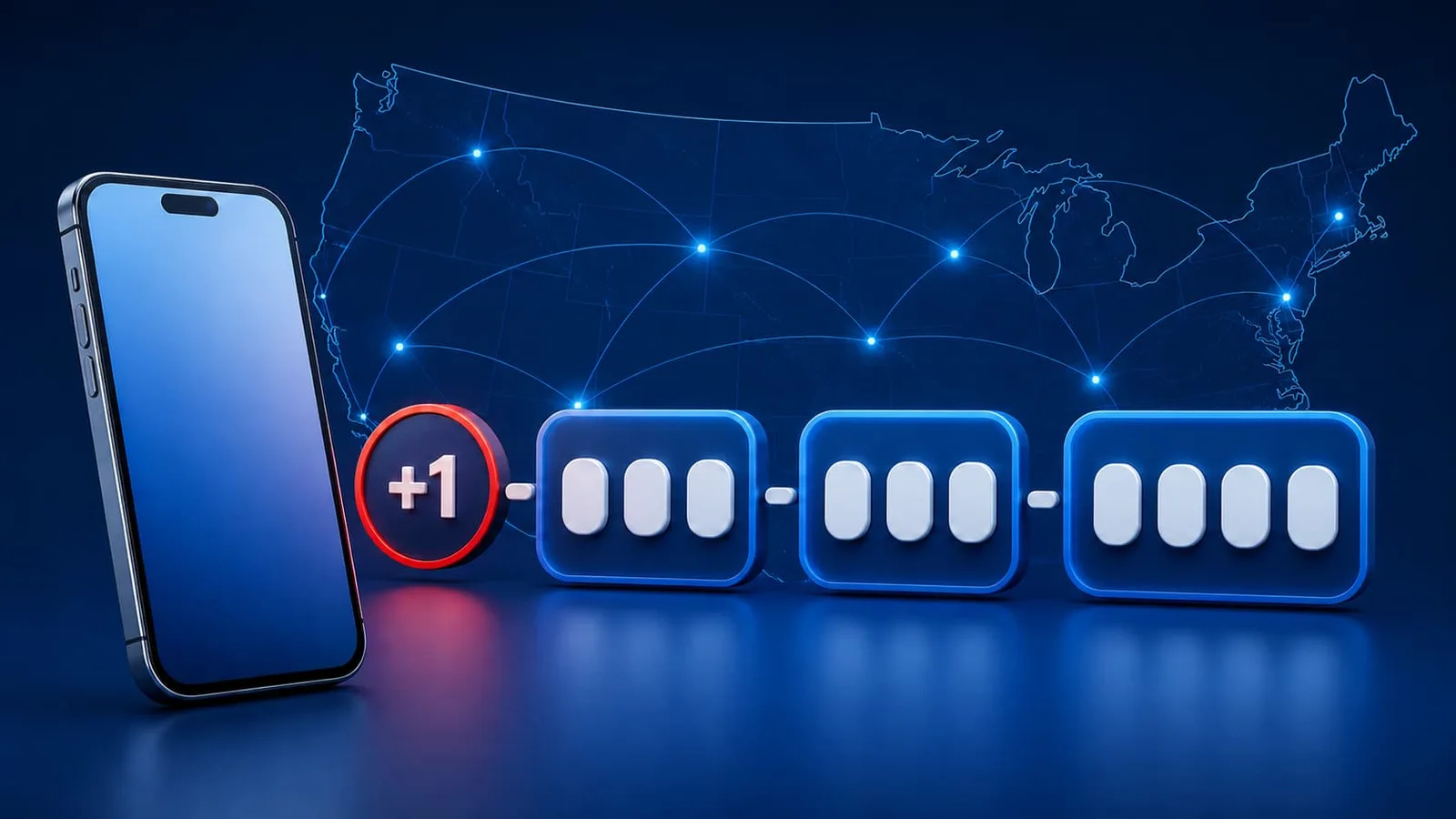
US numbers are part of the North American Numbering Plan. NANPA explains that a standard number contains ten digits: a three-digit area code followed by a seven-digit local number.
In international format, it looks like this:
+1 202 555 0123
+1is the calling code used by the North American Numbering Plan.202is the area code in this example.555 0123is the seven-digit local number.
The +1 code is shared by the United States, Canada, and several other NANP territories, so +1 alone does not prove that a number is based in the United States. The area code and carrier data provide more context.
When a form already has “United States (+1)” selected, it may ask for only the ten national digits. Other forms expect the full international version. Adding +1 twice—or removing a required digit—is a common reason a message is never sent.
Why verification texts sometimes fail
Temporary and virtual numbers are useful, but no honest provider can promise that every number will work with every website. Several things can stop a message before it reaches the inbox.
The sender does not accept that line type
Phone-number lookup tools can distinguish mobile, landline, and different types of VoIP numbers. Some platforms accept only specific line types, especially when an account involves money, identity, or abuse risk.
The number has been used too many times
Public numbers are shared. If many people previously used the same line on one platform, that platform may limit or block it.
The country or format is wrong
Selecting the wrong country, entering +1 twice, or dropping a digit can prevent the request from being submitted correctly.
The number cannot receive that kind of message
Not every valid phone number supports SMS. Some numbers are voice-only, landline, or unable to receive messages from short codes and automated senders.
The sender is delayed or rate-limiting requests
The problem may be on the sending side. Wait briefly before requesting another code, and do not create a loop of repeated requests.
The number was rotated
Temporary numbers are not designed to stay available forever. If you used one in the past, there is no guarantee that you can return later and receive another recovery message.
check this : Verification Code Not Received? 12 Reasons Your SMS Isn't Arriving—and How to Fix It
Safety rules worth following
Getting a number without a SIM is easy. Using it wisely requires a little more judgment.
Assume every public inbox can be read by someone else. Do not send personal details, recovery links, financial codes, or private conversations to it.
Do not attach a temporary number to an important account. If the number disappears, you may lose your recovery path with it.
Follow the platform's terms. A website may prohibit virtual numbers, multiple accounts, or certain uses even when the number itself is legal.
Use a number you control for long-term security. A carrier plan, renewable eSIM, or private number is a better fit for accounts you intend to keep.
Move away from SMS when a stronger option is available. For an important account, an authenticator app, passkey, or hardware security key can be a better long-term authentication method.
Never use temporary numbers for fraud or impersonation. Privacy tools are not a license to deceive people or bypass safeguards.
Frequently asked questions
What does “US temp number” mean?
It usually means a temporary phone number using a US area code and the +1 calling prefix. Depending on the provider, it may be a public receive-only number, a private rented number, or an app-based VoIP line.
Can I get a US number for free without a SIM card?
Yes. Public SMS websites and some second-number apps offer free options. Free public numbers have shared inboxes and may be reused, while apps may require an account, show ads, or charge for keeping the number.
Can I use a temporary US number outside the United States?
Usually, because the inbox is accessed over the internet. The website or app sending the message may still apply location, identity, or line-type restrictions. A US number does not make a user physically located in the United States.
Can a temporary number receive every verification code?
Acceptance depends on the sender, the number's line type, its previous use, and whether it can receive messages from that sender. Avoid any provider claiming guaranteed compatibility with every platform.
Is a temporary phone number the same as a fake number?
Not necessarily. A working temporary number routes real incoming messages for a limited period. A fake-number generator may only create digits that look correctly formatted and cannot receive anything.
Are free temporary SMS messages private?
On a public service, messages can be visible to anyone who opens the inbox. Use a private or personally controlled line whenever confidentiality matters.
Can I keep a temporary number permanently?
You should assume that a free public number can change or disappear without notice. Some paid apps, private rentals, and eSIM plans let you keep a number as long as you maintain the subscription, but the provider's retention and renewal rules still apply.
Can I send texts or make calls from a public temporary number?
Most public temporary-number services are receive-only. If you need two-way SMS or calls, choose a second-number app, mobile eSIM plan, or VoIP service that explicitly includes those features.
Does every eSIM give me a US phone number?
An eSIM is the digital method used to activate a carrier plan. The plan itself determines whether you receive a phone number, voice service, SMS, and data. Many travel eSIMs are data-only.
Final thoughts
Getting a US phone number without a physical SIM card is no longer difficult. The real question is how much privacy, reliability, and control you need.
For a one-time, non-sensitive incoming message, you can view available US numbers for receiving SMS online. For a private conversation, an important account, or any number you expect to keep, use a private service or renewable mobile plan that gives you continued control of the line.
Choose the option that fits the job, understand its limits before you use it, and never treat a public inbox as private.